
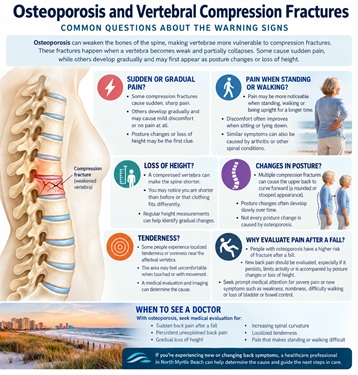
Osteoporosis can weaken the bones of the spine and increase the risk of vertebral compression fractures. These fractures happen when one of the vertebrae becomes weak and partially collapses. Some cause sudden pain, while others develop gradually and may first appear as posture changes or loss of height.
For people in North Myrtle Beach, knowing the possible warning signs can help determine when new or unexplained back symptoms should be evaluated.
Why Can Osteoporosis Cause Compression Fractures?
Osteoporosis reduces bone strength. As the vertebrae become weaker, they may be more vulnerable to fractures from:
- A fall
- An awkward movement
- Bending or twisting
- Lifting
- Everyday stress on weakened bones
Because osteoporosis often causes no obvious symptoms before a fracture occurs, new back pain should not automatically be assumed to be a muscle strain or normal aging.
Does a Vertebral Compression Fracture Always Cause Sudden Pain?
No. Symptoms can vary.
Some compression fractures cause sudden, sharp back pain. A person may remember exactly when the pain started, especially if symptoms began after a fall or specific movement.
Other fractures may develop more gradually and cause:
- Mild or aching discomfort
- Pain that slowly becomes more noticeable
- Little or no obvious pain
- Changes in posture
- Loss of height
In some cases, posture or height changes may provide the first clue that a vertebra has compressed.
Can Pain Become Worse When Standing or Walking?
Yes. Some people notice that pain becomes more noticeable when they stand, walk or remain upright for an extended period.
Possible patterns may include:
- Increased pain while standing
- Discomfort during walking
- Pain after being upright for a longer period
- Improvement when sitting or lying down
However, this pattern is not unique to a compression fracture. Arthritis, muscle problems and other spinal conditions can cause similar symptoms. A medical evaluation can help identify the actual cause.
Can Osteoporosis Lead to Loss of Height?
Loss of height can be an important warning sign.
When a vertebra compresses, the spine can become slightly shorter. If more than one vertebra is affected, the change may become more noticeable over time.
Possible signs include:
- Measuring shorter than before
- Clothing fitting differently
- A noticeable change in posture
- Family members noticing a change in height
Regular height measurements may help identify gradual changes that otherwise could be overlooked.
Why Can Posture Change?
Compression fractures can change the normal shape of the spine.
If several vertebrae become compressed, the upper back may gradually curve forward. This can create a rounded or stooped appearance.
Posture changes may:
- Develop slowly
- Become more noticeable over time
- Occur along with height loss
- Affect how a person stands or walks
Not every posture change is caused by osteoporosis. Arthritis, muscle weakness and other conditions can also affect posture, so unexplained changes should be evaluated.
Can a Vertebral Compression Fracture Cause Tenderness?
Yes. Some people experience localized tenderness or soreness near the affected vertebra.
Symptoms may include:
- Tenderness in one area of the back
- Soreness with movement
- Discomfort when changing positions
- Pain when standing or walking
Symptoms alone cannot confirm a fracture. A healthcare provider may perform a physical examination and recommend imaging if a compression fracture is suspected.
Why Should Back Pain After a Fall Be Evaluated?
A fall does not automatically mean that a vertebra has fractured. However, someone with osteoporosis or known low bone density has a greater risk of fracture after a fall.
New back pain after a fall deserves attention, especially when it:
- Persists instead of improving
- Limits normal activity
- Becomes severe
- Is accompanied by posture changes
- Occurs with noticeable loss of height
Evaluation can help determine whether the symptoms are caused by a compression fracture, muscle injury or another condition.
Seek prompt medical attention after an injury if there is severe pain or new symptoms such as:
- Weakness
- Numbness
- Difficulty walking
- Loss of bladder or bowel control
How Are Compression Fractures Diagnosed?
Evaluation usually starts with a discussion of symptoms, medical history and osteoporosis risk.
A healthcare provider may:
- Examine the spine
- Check for tenderness
- Evaluate posture
- Compare current height with previous measurements
- Recommend an X-ray
In some cases, MRI or CT imaging may be used to better understand the injury or rule out other causes of pain.
When Should Someone With Osteoporosis See a Doctor?
Having osteoporosis does not mean every episode of back pain is caused by a fracture.
However, it is a good idea to seek medical evaluation for:
- Sudden back pain after a fall
- Persistent unexplained back pain
- Gradual loss of height
- Increasing spinal curvature
- Localized tenderness
- Pain that makes standing or walking difficult
For patients in North Myrtle Beach, early evaluation can help determine whether symptoms are related to a compression fracture or another spine condition and guide the next steps in care.
Frequently Asked Questions About Osteoporosis and Vertebral Compression Fractures
Can a compression fracture happen without a major fall?
Yes. When bones are significantly weakened, even everyday movements can sometimes place enough stress on a vertebra to cause a fracture.
Can someone have a compression fracture without knowing it?
Yes. Some fractures cause little or no noticeable pain and may first become apparent through height loss or posture changes.
Does osteoporosis itself cause back pain?
Osteoporosis often has no symptoms until a fracture occurs. Back pain may come from a compression fracture or from another spinal condition.
Does every compression fracture require surgery?
No. Many compression fractures can be treated without surgery. Treatment depends on the fracture, the severity of symptoms and the individual’s overall health.
Call Coastal Carolinas Interventional Spine to schedule an appointment and learn what may be causing your symptoms.
Check our Facebook page for more educational articles
Coastal Carolinas Interventional Spine
416 Main Street
North Myrtle Beach, SC 29582
(910) 755-6060
https://www.coastalcarolinasinterventionalspine.com/
[email protected]
Coastal Carolinas Interventional Spine
10 Doctor Circle
Suite #2
Supply, NC 28462
Areas Served:
Myrtle Beach SC, North Myrtle Beach SC, Little River SC, Shallotte NC, Calabash NC, Supply NC