
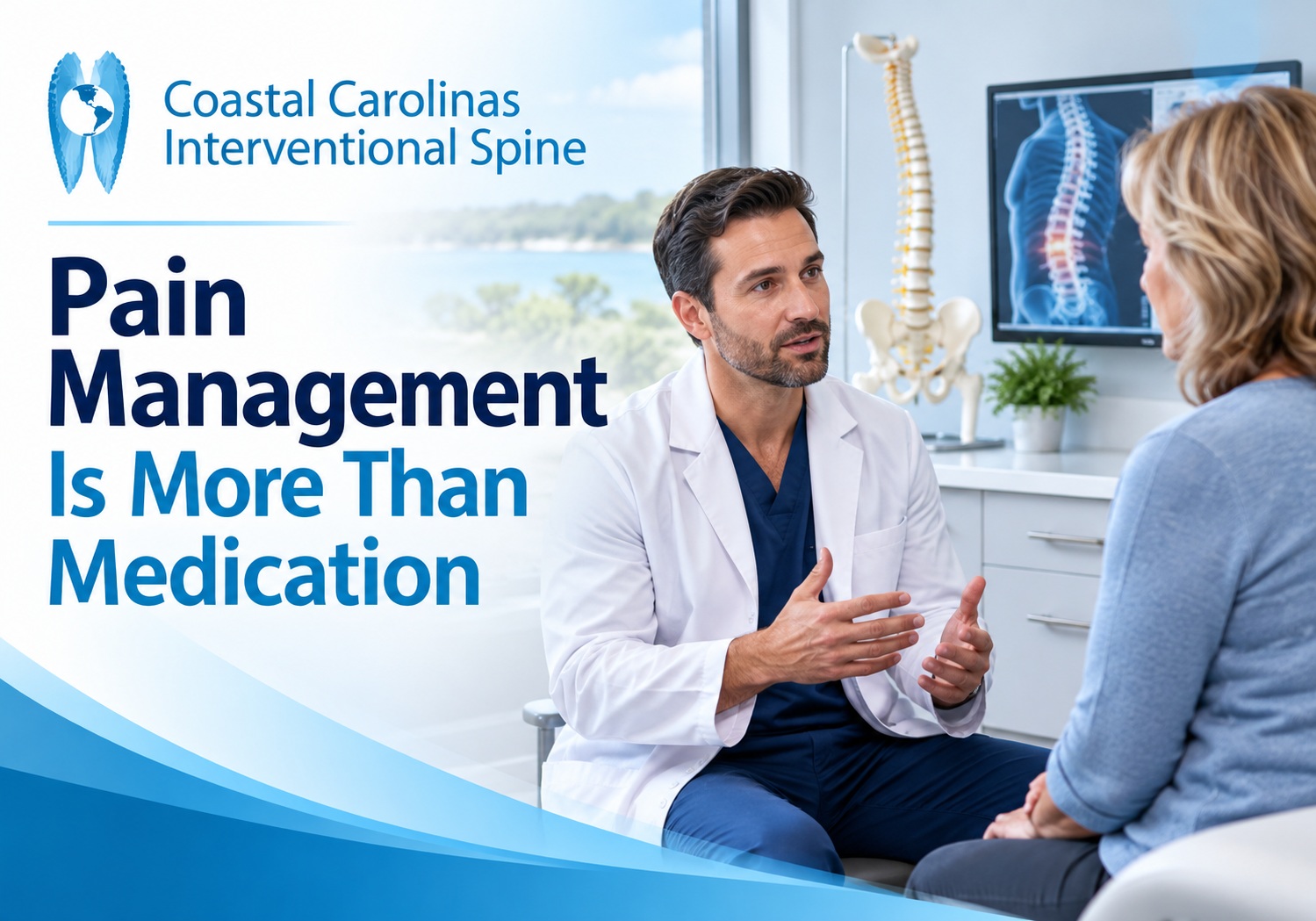
Pain management is much broader than taking pain medication. Depending on the cause of pain, treatment may include diagnosis, rehabilitation, activity changes, non-surgical care, targeted procedures, ongoing monitoring, and referral to another specialist when appropriate.
For patients in North Myrtle Beach, the goal is often to understand what may be causing symptoms and develop a treatment plan that supports mobility, function, and daily activities. Treatment does not always eliminate pain completely, and results can vary from person to person.
Why Does Pain Management Start With a Diagnosis?
Effective treatment usually begins with determining what may be causing the pain.
Back, neck, joint, or nerve-related pain can sometimes produce similar symptoms even when the underlying problem is different. A medical evaluation helps narrow down possible causes.
An evaluation may include:
- A review of symptoms and medical history
- A physical examination
- Testing strength, movement, and reflexes
- Discussion of previous treatments
- X-rays, MRI, or other testing when appropriate
Imaging alone may not explain every symptom. Doctors generally consider test results together with the physical examination and the patient’s description of the pain.
How Can Rehabilitation Help Manage Pain?
Rehabilitation can play an important role in pain management.
Physical therapy, therapeutic exercise, or a home exercise program may help patients improve strength, flexibility, balance, and movement. Rehabilitation can also help people learn safer ways to perform everyday activities.
Depending on the condition, rehabilitation may focus on:
- Strengthening supporting muscles
- Improving flexibility
- Restoring comfortable movement
- Improving posture or body mechanics
- Gradually increasing activity
Progress may take time. The appropriate program depends on the diagnosis, symptoms, overall health, and individual abilities.
Can Changing Activities Reduce Pain?
Activity changes may also be useful.
This does not always mean avoiding activity completely. Instead, patients may be advised to temporarily modify movements that aggravate symptoms while gradually returning to normal activities when appropriate.
Changes could include adjusting lifting techniques, taking more frequent breaks, modifying exercise, or changing how certain tasks are performed.
The goal is usually to remain as active as reasonably possible without repeatedly aggravating the problem.
What Non-Surgical Approaches May Be Considered?
Many conditions can initially be managed without surgery.
Depending on the diagnosis, non-surgical approaches may include:
- Physical therapy
- Therapeutic exercise
- Activity modification
- Heat or cold when appropriate
- Certain medications
- Lifestyle changes
- Home exercise programs
- Interventional procedures
Not every treatment is suitable for every patient. A plan should be based on the suspected source of pain and the person’s overall medical condition.
What Are Targeted Pain Management Procedures?
Some patients may benefit from procedures directed at a specific structure believed to be contributing to symptoms.
Interventional pain management may include certain injections, nerve-related procedures, or other minimally invasive techniques.
These treatments are generally considered after reviewing the patient’s symptoms, examination findings, imaging when available, and previous treatment.
A targeted procedure may be used to reduce symptoms, improve function, support rehabilitation, or provide additional diagnostic information. It should not be assumed that a procedure will completely eliminate pain.
Why Is Monitoring an Important Part of Treatment?
Pain management is often an ongoing process rather than a single appointment or treatment.
Follow-up visits allow the healthcare team to evaluate whether symptoms, mobility, and function are changing.
Monitoring may help determine:
- Whether treatment is helping
- Whether symptoms are improving or worsening
- Whether side effects have developed
- Whether additional testing is needed
- Whether the treatment plan should change
Treatment may be adjusted over time depending on the patient’s response.
When Might a Referral Be Needed?
Sometimes another healthcare professional may need to become involved.
Depending on the condition, referral could be made to a physical therapist, neurologist, surgeon, rheumatologist, primary care physician, or another specialist.
A referral does not necessarily mean surgery or another major treatment will be recommended. Instead, it allows the patient to receive additional evaluation when appropriate.
Pain Management in North Myrtle Beach
People seeking pain management in North Myrtle Beach have options beyond relying only on medication.
At Coastal Carolinas Interventional Spine, evaluation can include reviewing symptoms, medical history, physical findings, previous treatments, and imaging when appropriate. From there, non-surgical and interventional options may be considered based on the individual’s condition.
The goal is to develop a thoughtful treatment plan focused on improving comfort, movement, and everyday function while continuing to monitor progress over time.
Check our Facebook page for more educational articles
Coastal Carolinas Interventional Spine
416 Main Street
North Myrtle Beach, SC 29582
(910) 755-6060
https://www.coastalcarolinasinterventionalspine.com/
[email protected]
Coastal Carolinas Interventional Spine
10 Doctor Circle
Suite #2
Supply, NC 28462
Areas Served:
Myrtle Beach SC, North Myrtle Beach SC, Little River SC, Shallotte NC, Calabash NC, Supply NC