
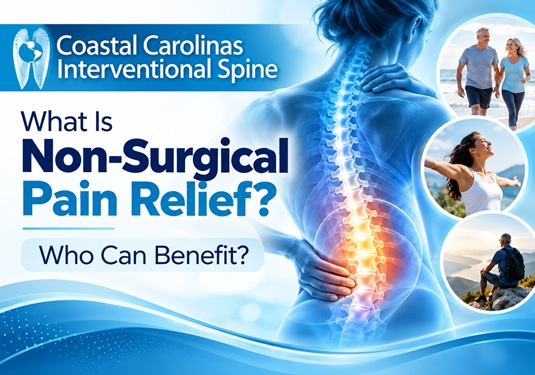
Living with chronic pain can make even the simplest daily activities difficult. Walking, working, sleeping, driving, or spending time with family may become increasingly challenging when pain never seems to go away. That’s where non-surgical pain relief comes in.
Fortunately, surgery is not the only option. Today, advances in non-surgical pain relief allow many patients to reduce pain, restore function, and improve their quality of life without undergoing an operation.
At Coastal Carolinas Interventional Spine, we specialize in personalized chronic pain treatment designed to identify the source of pain and provide targeted solutions that help patients return to the activities they enjoy.
What Is Non-Surgical Pain Relief?
Non-surgical pain relief refers to medical treatments that relieve pain without major surgery. Instead of removing or repairing damaged tissue through an operation, these treatments focus on reducing inflammation, calming irritated nerves, and improving how the body functions.
Interventional pain management combines advanced imaging, minimally invasive procedures, physical rehabilitation, and lifestyle recommendations to create a customized treatment plan for each patient.
The goal is to:
- Reduce pain
- Improve mobility
- Restore daily function
- Delay or avoid surgery whenever appropriate
- Improve overall quality of life
Many patients are surprised to learn they have several effective treatment options before surgery ever becomes necessary.
Common Conditions Treated with Non-Surgical Pain Relief
Many painful conditions respond well to non-surgical pain relief, including:
- Chronic neck pain
- Chronic back pain
- Herniated discs
- Degenerative disc disease
- Arthritis
- Facet joint pain
- Sacroiliac joint dysfunction
- Sciatica
- Spinal stenosis
- Pinched nerves
- Osteoporosis-related pain
- Joint pain
- Nerve pain
- Chronic headaches caused by spinal conditions
Every patient’s pain is different, which is why an accurate diagnosis is essential before beginning treatment.
Who Can Benefit from Non-Surgical Pain Relief?
Many people assume they must simply live with chronic pain because of age or previous injuries. In reality, many patients are excellent candidates for non-surgical pain relief.
You may benefit if you:
- Have experienced pain for several months
- Have pain that limits work or daily activities
- Have pain that keeps returning
- Have difficulty sleeping because of pain
- Have pain despite medications
- Want to avoid surgery
- Are not medically able to undergo surgery
- Have been told surgery may eventually be necessary but want to explore conservative options first
Older adults often benefit because minimally invasive treatments generally require little downtime compared to traditional surgery.
How Non-Surgical Pain Relief Works
Rather than masking symptoms with medication alone, non-surgical back pain relief focuses on treating the source of pain whenever possible.
Treatment plans may include:
Image-Guided Injections
These procedures deliver medication directly to the painful area using advanced imaging for accuracy.
Benefits include:
- Reduced inflammation
- Improved mobility
- Faster recovery
- Better pain control
- Diagnostic information to confirm the pain source
Nerve Blocks
Nerve blocks interrupt pain signals traveling from irritated nerves to the brain.
They may be recommended for:
- Neck pain
- Back pain
- Joint pain
- Certain headache disorders
- Chronic nerve pain
Physical Rehabilitation
Movement remains an important part of recovery.
A treatment plan may include:
- Stretching
- Strengthening exercises
- Improved posture
- Core stabilization
- Activity modification
Improved strength helps reduce stress placed on painful joints and the spine.
Medication Management
While medications can play an important role, they are usually just one part of a comprehensive treatment plan.
The goal is to provide symptom relief while minimizing long-term dependence whenever possible.
Is Surgery Always Necessary for Chronic Pain?
One of the most common questions patients ask is whether surgery is inevitable.
The answer is often no.
Many causes of chronic pain respond well to conservative care. In fact, physicians frequently recommend trying chronic pain treatment before considering surgery unless there is a medical emergency or significant nerve damage.
Surgery may become necessary when:
- Conservative treatment has failed
- Progressive neurological symptoms develop
- Severe structural instability exists
- There is loss of bowel or bladder function
- Significant weakness continues to worsen
For many patients, however, surgery can be delayed or avoided altogether with the right treatment plan.
Benefits of Trying Chronic Pain Treatment First
Choosing chronic pain treatment before surgery offers several potential advantages.
Lower Risk
Every surgical procedure carries risks such as:
- Infection
- Bleeding
- Anesthesia complications
- Scar tissue
- Longer recovery
Minimally invasive procedures generally involve fewer risks.
Faster Recovery
Many interventional pain procedures are performed on an outpatient basis.
Patients often:
- Return home the same day
- Resume normal activities sooner
- Require minimal downtime
Personalized Care
No two patients experience pain in exactly the same way.
Comprehensive chronic pain treatment begins with understanding:
- Medical history
- Physical examination
- Imaging studies
- Lifestyle
- Activity goals
Treatment is then tailored specifically to each patient.
Improved Quality of Life
Successful pain management isn’t simply about lowering pain scores.
It also helps patients:
- Walk farther
- Sleep better
- Enjoy hobbies
- Exercise comfortably
- Return to work
- Spend more time with family
- Maintain independence
These improvements often have a significant impact on overall health and emotional well-being.
Here’s what our client has to say:
When Should You See a Pain Management Specialist?
You should consider seeing a pain management specialist if:
- Pain lasts longer than three months
- Pain interferes with work
- Pain limits everyday activities
- Medications are no longer helping
- Physical therapy alone has not resolved symptoms
- Your primary care provider recommends additional evaluation
- You want to avoid surgery if possible
Early evaluation often leads to better long-term outcomes.
Why Accurate Diagnosis Matters
Treating pain without identifying its cause can delay recovery.
At Coastal Carolinas Interventional Spine, we perform comprehensive evaluations to determine exactly where your pain originates before recommending treatment.
This approach allows us to provide targeted therapies instead of relying on generalized pain management.
A Patient-Centered Approach
Every patient deserves compassionate care and individualized attention.
Our team works closely with patients to explain their diagnosis, discuss available options, answer questions, and develop realistic treatment goals.
Whether your pain stems from arthritis, spinal conditions, nerve irritation, or previous injuries, our goal is to help you move more comfortably and regain confidence in daily life.
Take the First Step Toward Lasting Relief
Living with chronic pain does not automatically mean surgery is your only option. Modern non-surgical pain relief offers many effective treatments that can reduce discomfort, improve mobility, and help you return to the activities you enjoy.
If you have been searching for answers or wondering whether surgery is truly necessary, a personalized evaluation can help determine the most appropriate chronic pain treatment for your condition.
At Coastal Carolinas Interventional Spine, we are committed to helping patients find safe, effective, and individualized solutions for chronic pain.
Here’s what our client has to say:
Frequently Asked Questions About Non-Surgical Pain Relief
What types of pain can be treated without surgery?
Non-surgical pain relief may be used for many types of chronic neck, back, joint, and nerve pain. Conditions such as herniated discs, arthritis, sciatica, spinal stenosis, facet joint pain, and sacroiliac joint dysfunction may respond to non-surgical treatment, depending on the cause and severity of symptoms.
How do I know which non-surgical pain treatment is right for me?
The right treatment depends on your diagnosis, symptoms, medical history, examination findings, and treatment goals. A pain management specialist may recommend options such as image-guided injections, nerve blocks, physical rehabilitation, medication management, or a combination of treatments.
Can non-surgical pain relief help me avoid surgery?
In some cases, yes. Many patients are able to improve pain and function with non-surgical treatment. However, surgery may still be necessary when there is severe structural damage, progressive weakness, significant nerve problems, or certain emergency symptoms.
How quickly can non-surgical pain treatments provide relief?
Relief varies by patient and by treatment. Some people notice improvement soon after an interventional procedure, while others may need several weeks of rehabilitation or a series of treatments before they experience meaningful improvement.
Are non-surgical pain procedures performed in a hospital?
Many interventional pain procedures are performed on an outpatient basis, which means patients can often return home the same day. The exact setting depends on the procedure and the patient’s medical needs.
When should I see a pain management specialist?
Consider an evaluation if pain has lasted longer than three months, interferes with sleep or daily activities, keeps returning, or has not improved with medications or physical therapy. A specialist can help identify the source of pain and discuss appropriate treatment options.
Call (910) 755-6060 today to schedule your consultation and learn how non-surgical pain relief may help you reclaim your quality of life.
Check our Facebook page for more educational articles
Coastal Carolinas Interventional Spine
416 Main Street
North Myrtle Beach, SC 29582
(910) 755-6060
https://www.coastalcarolinasinterventionalspine.com/
[email protected]
Coastal Carolinas Interventional Spine
10 Doctor Circle
Suite #2
Supply, NC 28462
Areas Served:
Myrtle Beach SC, North Myrtle Beach SC, Little River SC, Shallotte NC, Calabash NC, Supply NC