
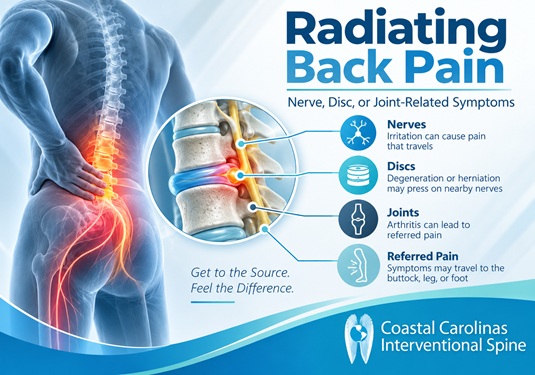
Back pain can sometimes spread into the buttock, hip, thigh, calf, or foot because the nerves, joints, discs, and other structures of the lower spine are closely connected. Pain may travel because a nerve is irritated, or it may be referred from another structure. The location of pain alone does not always identify the cause.
For patients in North Myrtle Beach, an evaluation can help determine whether symptoms appear to be related to a nerve, spinal disc, joint, narrowing around the nerves, or another source.
Why Can Back Pain Spread Into the Leg?
The nerves that leave the lower spine travel into the buttocks and legs. When one of these nerves becomes irritated or compressed, pain may be felt along part of that nerve pathway.
Patients may describe nerve-related symptoms as:
- Burning
- Shooting
- Electric
- Tingling
- Numbness
- Pins and needles
However, not all pain that travels into the hip or thigh is nerve-related. Spinal joints, muscles, discs, and other structures can also cause referred pain.
Learn more about back and leg pain and nerve-related symptoms.
Is Radiating Back Pain Always Sciatica?
No. Sciatica generally refers to symptoms involving irritation of nerves that contribute to the sciatic nerve.
Sciatica may cause pain that travels from the lower back or buttock down the leg. Tingling, numbness, or weakness may also occur.
However, buttock, hip, or thigh pain does not automatically mean someone has sciatica. Joint irritation, disc problems, muscle-related pain, and other conditions can create similar symptoms.
How Can Discs Cause Leg Pain?
The discs between the vertebrae help cushion the spine. If a disc bulges or herniates and irritates a nearby nerve root, symptoms may extend into the buttock, thigh, lower leg, or foot.
However, finding a disc abnormality on an MRI does not automatically prove that it is causing a person’s symptoms. Doctors compare imaging findings with the patient’s history, examination, and symptom pattern.
Can Spinal Narrowing Cause Leg Symptoms?
 Spinal stenosis occurs when spaces around the nerves become narrower. In some people, this may contribute to aching, heaviness, numbness, tingling, or pain in the buttocks or legs.
Symptoms may become more noticeable while standing or walking and improve when sitting or changing position.
Because other conditions can produce similar symptoms, this pattern should not be diagnosed based on symptoms alone.
What Is Referred Pain?
Referred pain means discomfort is felt somewhere other than where the problem begins.
For example, irritation involving a spinal joint may cause lower back discomfort that also spreads into the buttock, hip, or upper thigh. This type of pain may not follow a specific nerve pathway.
Facet joints and sacroiliac joints can both produce pain patterns that overlap with other causes of back and hip discomfort.
Why Does the Physical Examination Matter?
A doctor may evaluate strength, reflexes, sensation, walking, range of motion, tenderness, and how certain movements affect symptoms.
These findings help determine whether the pain pattern appears nerve-related, joint-related, disc-related, or connected to another structure.
Imaging may be appropriate in some cases, but scans should be interpreted along with the examination and symptoms.
Common Questions About Radiating Back Pain
Why does my back pain go into my buttock?
Nerve irritation is one possibility, but joints, discs, muscles, and other structures can also refer pain into the buttock.
Does pain down the leg always mean a pinched nerve?
No. A nerve problem may cause radiating pain, especially with tingling or numbness, but other conditions can produce similar symptoms.
Can a disc problem cause leg pain without severe back pain?
Yes. In some cases, nerve irritation from a disc problem may cause symptoms that are more noticeable in the leg than in the lower back.
Do I automatically need an MRI?
No. Imaging depends on symptoms, examination findings, medical history, duration of pain, and whether neurological symptoms are present.
When Should Radiating Pain Be Evaluated?
Persistent or worsening back pain that travels into the leg should be evaluated when it limits walking, sleep, work, or normal activities, especially if numbness, tingling, or weakness develops.
Urgent medical evaluation may be needed for new bowel or bladder problems, saddle-area numbness, severe weakness, major trauma, fever, or rapidly worsening neurological symptoms.
At Coastal Carolinas Interventional Spine, patients in North Myrtle Beach are evaluated using their symptoms, physical examination, neurological findings, and diagnostic testing when appropriate.
If radiating back pain is affecting your daily activities, call Coastal Carolinas Interventional Spine to schedule an evaluation.
Check our Facebook page for more educational articles
Coastal Carolinas Interventional Spine
416 Main Street
North Myrtle Beach, SC 29582
(910) 755-6060
https://www.coastalcarolinasinterventionalspine.com/
[email protected]
Coastal Carolinas Interventional Spine
10 Doctor Circle
Suite #2
Supply, NC 28462
Areas Served:
Myrtle Beach SC, North Myrtle Beach SC, Little River SC, Shallotte NC, Calabash NC, Supply NC