
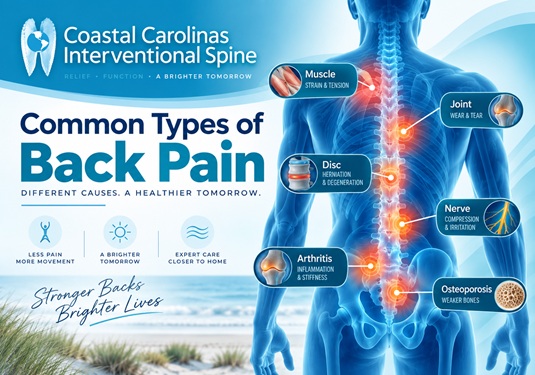
Back pain can come from muscles, joints, spinal discs, nerves, arthritis, weakened bones, or a combination of these problems. Because several conditions can create similar symptoms, pain location alone does not always reveal the cause. A medical evaluation helps determine which structures may be involved and which treatment options may be appropriate.
At Coastal Carolinas Interventional Spine, patients in North Myrtle Beach and surrounding communities are evaluated based on their symptoms, medical history, physical examination, and, when appropriate, diagnostic imaging.
What Does Muscle-Related Back Pain Feel Like?
Muscle-related back pain often develops after lifting, twisting, overuse, repetitive activity, or an unfamiliar physical task.
Symptoms may include:
- Aching or soreness
- Muscle tightness
- Spasms
- Pain with movement
- Tenderness around the affected area
Although muscle strains are common, ongoing pain should not automatically be assumed to come from a muscle. Other spinal conditions can create similar discomfort.
What Causes Joint-Related Back Pain?
The spine contains small facet joints that help control movement and stability. The sacroiliac joints, which connect the lower spine and pelvis, can also contribute to pain.
Joint-related symptoms may include localized aching, stiffness, or pain that becomes worse with certain movements or positions.
Because joint pain can resemble muscle or disc-related symptoms, a physical examination can help identify which structures may be contributing.
How Can Spinal Discs Cause Back Pain?
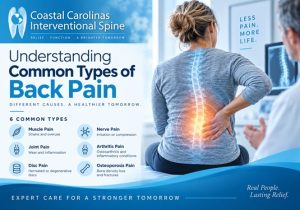 Spinal discs sit between the vertebrae and help absorb pressure placed on the spine.
Over time, discs may develop degenerative changes. A disc may also bulge or herniate. When a disc is contributing to symptoms, pain may stay primarily in the back or may irritate a nearby nerve.
However, seeing a disc abnormality on an MRI does not automatically mean that the disc is causing the patient’s pain. Imaging findings must be considered together with symptoms and examination findings.
What Does Nerve-Related Back Pain Feel Like?
Nerve-related back pain may develop when a spinal nerve becomes irritated, inflamed, or compressed.
Symptoms may include:
- Shooting or sharp pain
- Burning sensations
- Tingling
- Numbness
- Weakness
- Pain that travels into the buttock, leg, or foot
Conditions such as a herniated disc or spinal stenosis may affect nearby nerves. The exact symptoms depend on which nerve is involved and how severely it is irritated.
How Can Arthritis Cause Back Pain?
Arthritis can affect the joints of the spine and contribute to stiffness, reduced movement, and aching pain.
Osteoarthritis may develop as joint cartilage and other spinal structures change over time. These changes may also contribute to narrowing around the spinal nerves.
There are also inflammatory forms of arthritis that can affect the spine. Because different types of arthritis require different approaches to care, identifying the underlying condition matters.
How Is Osteoporosis Related to Back Pain?
Osteoporosis weakens bones and increases the risk of fractures.
The condition itself may not always cause pain. However, weakened vertebrae can develop compression fractures, which may lead to sudden or persistent back pain.
Compression fractures may sometimes occur after relatively minor movements or injuries, especially in people with reduced bone density.
Why Can Different Types of Back Pain Feel Similar?
Back pain can be difficult to diagnose based on symptoms alone because the structures of the spine work together.
For example, a disc problem may irritate a nerve. Arthritis may affect a joint while also narrowing the space around a nerve. Muscles may tighten or spasm in response to pain coming from another spinal structure.
Some patients may also have more than one source of pain at the same time.
Why Does an Accurate Diagnosis Matter?
An accurate diagnosis helps guide treatment toward the condition that is most likely causing the symptoms.
A back pain evaluation may include questions about when symptoms started, where the pain travels, what makes it better or worse, and whether numbness or weakness is present.
The physical examination may assess movement, strength, reflexes, sensation, and areas of tenderness. When needed, X-rays, MRI, CT scans, or other testing may provide additional information.
Imaging alone does not always identify the pain source. Doctors compare imaging findings with the patient’s symptoms and physical examination before recommending treatment.
When Should Back Pain Be Evaluated?
Medical evaluation may be appropriate when back pain persists, repeatedly returns, interferes with daily activities, or includes numbness, tingling, or weakness.
Urgent evaluation may be needed when pain is associated with significant trauma, fever, new bowel or bladder problems, or worsening neurological symptoms.
For patients experiencing persistent or unexplained back pain in North Myrtle Beach, Coastal Carolinas Interventional Spine focuses on identifying the possible source of symptoms and determining appropriate next steps.
Understanding the Source of Your Back Pain
Back pain is a symptom, not a single diagnosis. Muscle, joint, disc, nerve, arthritis, and osteoporosis-related conditions can all produce discomfort, and their symptoms may overlap.
If back pain is affecting your mobility, work, sleep, or daily activities, call Coastal Carolinas Interventional Spine to schedule an evaluation and learn what may be contributing to your symptoms.
This article provides general educational information and does not replace professional medical advice, diagnosis, or emergency care.
Check our Facebook page for more educational articles
Coastal Carolinas Interventional Spine
416 Main Street
North Myrtle Beach, SC 29582
(910) 755-6060
https://www.coastalcarolinasinterventionalspine.com/
[email protected]
Coastal Carolinas Interventional Spine
10 Doctor Circle
Suite #2
Supply, NC 28462
Areas Served:
Myrtle Beach SC, North Myrtle Beach SC, Little River SC, Shallotte NC, Calabash NC, Supply NC