
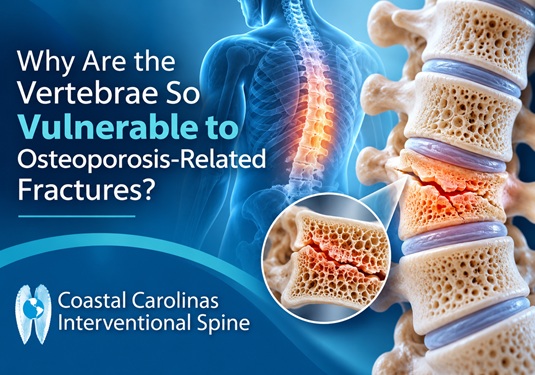
Osteoporosis is a condition that weakens bones, making them more likely to fracture. Although it can affect many parts of the skeleton, the vertebrae in the spine are especially vulnerable. When these bones lose strength, even minor movements or everyday activities may cause fractures that affect posture, height, mobility, and back pain.
For older adults in North Myrtle Beach, understanding how osteoporosis affects the spine can help identify warning signs before a fracture leads to lasting problems.
What Is Osteoporosis, and How Does It Affect the Spine?
Osteoporosis is a bone disease characterized by reduced bone strength and an increased risk of fractures. It develops when bone breakdown outpaces the formation of new bone, causing bones to become less dense and structurally weaker.
The spine contains 24 movable vertebrae that support the upper body, protect the spinal cord, and allow bending and twisting.
Each vertebra has a strong outer shell and an interior made of a porous network of bone called trabecular bone. This inner structure helps absorb and distribute weight.
As osteoporosis progresses, the internal bone network becomes thinner and less connected. Consequently, the vertebrae may struggle to withstand normal pressure.
Why Are Vertebrae More Likely to Fracture?
Vertebrae are particularly vulnerable because they contain substantial amounts of trabecular bone, which can lose strength rapidly with osteoporosis.
Additionally, the spine carries much of the body’s weight and experiences repeated pressure during daily activities.
Common situations that may trigger a fracture in weakened vertebrae include:
- Bending forward to pick up an object
- Lifting groceries or household items
- Twisting during everyday movements
- Coughing or sneezing forcefully
- Experiencing a minor fall
In advanced osteoporosis, a vertebral fracture can sometimes occur without an obvious injury.
A vertebral compression fracture occurs when a weakened spinal bone partially collapses under pressure, reducing its height and sometimes changing its shape.
Learn more about the warning signs in our article on osteoporosis and vertebral compression fractures.
How Can Osteoporosis Affect Posture and Height?
One of the most noticeable consequences of spinal fractures is a gradual change in posture.
When the front portion of a vertebra collapses, it may develop a wedge shape. Multiple wedge-shaped fractures can cause the upper back to curve forward, a condition known as kyphosis.
Possible changes include:
- Gradual loss of height
- Rounded shoulders or a hunched posture
- Difficulty standing completely upright
- Changes in balance and walking patterns
- Reduced space between the ribs and pelvis
Not every posture change indicates osteoporosis. However, unexplained height loss or increasing spinal curvature deserves medical evaluation.
Can Osteoporosis Cause Back Pain and Mobility Problems?
Osteoporosis itself typically does not cause pain until a fracture occurs.
A vertebral compression fracture may cause sudden, sharp back pain or persistent discomfort that develops gradually.
Pain may become more noticeable when standing, walking, bending, or changing positions. Some individuals experience relief when lying down.
Fractures can also affect mobility by changing spinal alignment and making everyday movements uncomfortable.
Over time, reduced activity may contribute to muscle weakness, stiffness, and balance problems, potentially increasing the risk of future falls.
However, some vertebral fractures cause little or no pain, making changes in height and posture important warning signs.
How Is Osteoporosis Diagnosed Before a Serious Fracture?
Because bone loss often develops without symptoms, testing is important for people at increased risk.
A DXA (DEXA) scan measures bone mineral density and helps assess fracture risk. Meanwhile, spinal X-rays or other imaging tests may identify existing compression fractures.
Risk factors include older age, menopause, previous fractures, family history, and long-term corticosteroid use.
Read our guide, How Osteoporosis Is Diagnosed, to understand bone-density testing and spinal imaging.
When Should North Myrtle Beach Residents Seek Evaluation?
For retirees and older adults in North Myrtle Beach, maintaining spinal health can support everyday activities such as walking, gardening, golfing, and enjoying time outdoors.
New back pain after a minor fall, unexplained height loss, or worsening posture should prompt medical attention.
Seek urgent care for severe back pain accompanied by new leg weakness, numbness, or bladder or bowel control problems.
Frequently Asked Questions About Osteoporosis
Can osteoporosis cause spinal fractures without a fall?
Yes. Severely weakened vertebrae may fracture during ordinary movements, including bending or lifting.
Can osteoporosis make you shorter?
Yes. Compression fractures can reduce vertebral height, causing gradual loss of overall height.
Does every spinal compression fracture cause pain?
No. Some fractures cause significant pain, while others produce few symptoms.
Can osteoporosis-related posture changes be prevented?
Early diagnosis, appropriate bone-strengthening treatment, exercise, and fall prevention can reduce fracture risk and help preserve mobility.
Can a bone-density scan detect spinal fractures?
A standard DXA scan measures bone density. X-rays or vertebral fracture assessment may be needed to identify fractures.
Protect Your Spine With Coastal Carolinas Interventional Spine
Osteoporosis-related spinal fractures can affect much more than bone strength. Recognizing changes in posture, height, mobility, or back pain may help prevent further complications.
If you live in North Myrtle Beach or a surrounding community and are concerned about weakened spinal bones, contact Coastal Carolinas Interventional Spine to discuss evaluation and appropriate treatment options. Call (910) 755-6060 to schedule a consultation.
Check our Facebook page for more educational articles
Coastal Carolinas Interventional Spine
416 Main Street
North Myrtle Beach, SC 29582
(910) 755-6060
https://www.coastalcarolinasinterventionalspine.com/
[email protected]
Coastal Carolinas Interventional Spine
10 Doctor Circle
Suite #2
Supply, NC 28462
Areas Served:
Myrtle Beach SC, North Myrtle Beach SC, Little River SC, Shallotte NC, Calabash NC, Supply NC