
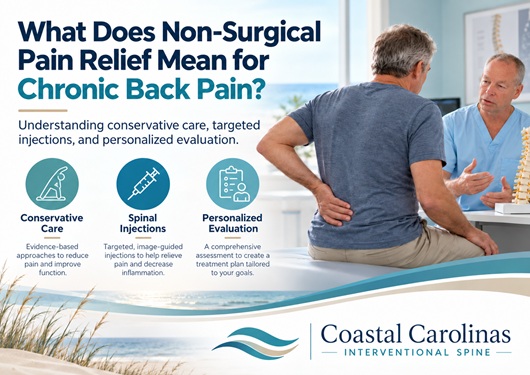
Non-surgical pain relief refers to treatments that help manage chronic back pain without an operation. Options may include physical therapy, medication, lifestyle changes, and targeted spinal injections. The goal is to reduce discomfort, improve mobility, and support daily activities. Treatment depends on the cause of pain, medical history, and individual needs.
For residents of North Myrtle Beach and the Grand Strand, chronic back pain can make everyday activities more difficult. Walking along the beach, playing golf, gardening, or simply getting out of bed may become uncomfortable. Fortunately, surgery is not always necessary to manage ongoing spine-related pain.
At Coastal Carolinas Interventional Spine, patients can receive a personalized evaluation to explore appropriate treatment options based on their symptoms and diagnosis.
What Is Considered Chronic Back Pain?
Chronic back pain is discomfort that lasts longer than 12 weeks, even when the original injury or irritation may have improved.
Pain can develop from several conditions, including:
- Herniated or bulging spinal discs
- Arthritis affecting the spinal joints
- Spinal stenosis, which narrows spaces around the nerves
- Degenerative changes in spinal discs
- Muscle strain or ongoing inflammation
- Irritated or compressed spinal nerves
Some people experience constant aching, while others notice sharp pain, stiffness, or discomfort that travels into the legs.
Because different conditions can produce similar symptoms, identifying the underlying cause is an important first step.
How Does Non-Surgical Pain Relief Help Manage Back Pain?
Non-surgical pain relief focuses on reducing symptoms and improving function without an operation.
Rather than relying on one treatment, a pain management doctor may recommend several approaches based on the patient’s condition.
Physical Therapy and Conservative Care
Conservative treatment often begins with methods that do not involve invasive procedures.
These may include:
- Physical therapy: Strengthening muscles that support the spine and improving flexibility.
- Activity modification: Adjusting movements that aggravate symptoms while remaining safely active.
- Medication management: Using appropriate medications to address pain or inflammation.
- Posture and body mechanics: Learning safer ways to sit, lift, bend, and move.
- Home exercise programs: Maintaining strength and mobility between appointments.
These approaches may help patients manage symptoms and perform daily activities more comfortably.
However, conservative care does not produce the same results for everyone.
What Types of Spinal Injections May Help Chronic Back Pain?
When conservative treatments provide insufficient improvement, certain patients may benefit from targeted injections.
Interventional spine procedures are designed to deliver medication or help identify specific sources of pain.
Common options include:
Epidural Steroid Injections
These injections deliver anti-inflammatory medication near irritated spinal nerves. They may help selected patients experiencing radiating leg pain associated with nerve inflammation.
Facet Joint Injections
Facet joints connect vertebrae and allow spinal movement. Injections may help evaluate or manage pain associated with these joints.
Medial Branch Blocks
These diagnostic injections temporarily numb small nerves that carry pain signals from facet joints. Results can help determine whether another procedure may be appropriate.
Radiofrequency Ablation
Although not an injection-based treatment, radiofrequency ablation uses controlled heat to interrupt certain pain signals. It may be considered for appropriately selected patients with confirmed facet-related pain.
Not every procedure is suitable for every diagnosis. Relief may be temporary, incomplete, or absent, and all procedures have potential risks.
How Does a Pain Management Doctor Evaluate Chronic Back Pain?
An accurate evaluation helps determine which treatment options are most appropriate.
A pain management doctor generally begins by reviewing symptoms, medical history, previous treatments, and how pain affects daily life.
The examination may include checking spinal movement, muscle strength, sensation, reflexes, and signs of nerve irritation.
When clinically appropriate, imaging such as MRI or X-rays may provide additional information.
The doctor then considers whether conservative care, an interventional procedure, further testing, or referral to another specialist is appropriate.
Important warning signs: New loss of bladder or bowel control, numbness around the groin or saddle area, or severe or rapidly worsening leg weakness requires immediate emergency medical evaluation. Back pain accompanied by fever, significant trauma, or other serious symptoms also needs prompt medical attention.
What Results Can Patients Realistically Expect?
The goal of treatment is not always complete pain elimination.
For many patients, meaningful progress may involve improved walking tolerance, better sleep, easier movement, or greater participation in daily activities.
Results depend on the underlying condition, overall health, treatment response, and other factors.
Some patients benefit from conservative care alone. Others may need additional procedures or specialist evaluation. Surgery may still be appropriate when certain structural problems or neurological symptoms require it.
Why Consider Spine Care in North Myrtle Beach?
Residents throughout North Myrtle Beach, Little River, Myrtle Beach, and the surrounding Grand Strand often want to remain active while managing persistent back discomfort.
Access to local interventional spine care allows patients to discuss their symptoms, understand available options, and develop a treatment plan suited to their needs.
Coastal Carolinas Interventional Spine emphasizes individualized evaluation rather than assuming one treatment works for everyone.
Ready to Explore Your Back Pain Treatment Options?
Chronic back pain should not automatically mean surgery is your only option.
Coastal Carolinas Interventional Spine helps patients in North Myrtle Beach and throughout the Grand Strand explore individualized approaches to managing spine-related pain.
Schedule a personalized consultation to discuss your symptoms, review potential causes, and learn whether non-surgical pain relief options may be appropriate for your condition.
Visit Coastal Carolinas Interventional Spine to learn more and take the next step toward managing your back pain.
Check our Facebook page for more educational articles.
Coastal Carolinas Interventional Spine
416 Main Street
North Myrtle Beach, SC 29582
(910) 755-6060
https://www.coastalcarolinasinterventionalspine.com/
[email protected]
Coastal Carolinas Interventional Spine
10 Doctor Circle
Suite #2
Supply, NC 28462
Areas Served:
Myrtle Beach SC, North Myrtle Beach SC, Little River SC, Shallotte NC, Calabash NC, Supply NC