
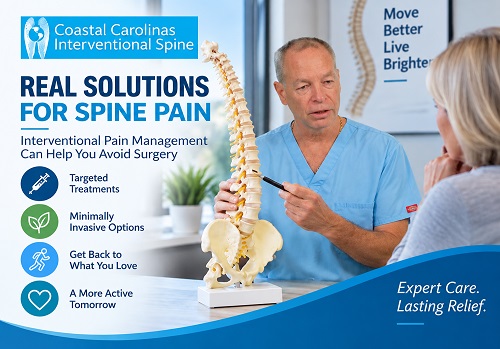
Living with chronic back, neck, or nerve pain can make everyday activities difficult. For many people, the thought of spine surgery may also bring concerns about recovery time, hospital stays, and changes to their normal routine. Interventional pain management offers another approach by using targeted, minimally invasive treatments designed to address the source of pain before surgery becomes necessary.
At Coastal Carolinas Interventional Spine, patients receive an individualized evaluation to determine what may be causing their symptoms and which treatment options may help. For many patients, especially active adults and retirees who want to remain independent, interventional procedures can provide meaningful pain relief while avoiding or delaying more invasive surgery.
What Is Interventional Pain Management?
Interventional pain medicine focuses on diagnosing and treating pain through targeted procedures rather than relying only on medication or immediately turning to surgery.
Instead of treating pain as a single symptom, an interventional pain physician looks for the specific structure that may be contributing to the problem. The source could involve spinal joints, irritated nerves, discs, muscles, or changes associated with arthritis and aging.
Once the likely source is identified, treatment can be directed to that area. Depending on the condition, this may help decrease inflammation, interrupt pain signals, or improve a patient’s ability to move and participate in rehabilitation.
Why Surgery Is Not Always the First Treatment
Some spinal conditions do require surgery, particularly when there is severe instability, progressive neurological damage, or another serious medical concern. However, many common causes of back and neck pain can initially be managed without an operation.
Degenerative changes in the spine are especially common as people age. Arthritis, spinal stenosis, disc changes, and irritated spinal joints may cause discomfort without automatically meaning that surgery is required.
A physician may first recommend conservative treatments such as physical therapy, activity changes, appropriate medications, or targeted procedures. The goal is to determine whether symptoms can be controlled while preserving normal movement and function.
How Interventional Pain Management Targets the Source of Pain
One advantage of interventional pain management is its ability to target a suspected source of pain instead of treating the entire body.
For example, pain that travels from the lower back into the leg may involve an irritated spinal nerve. In other cases, persistent lower back discomfort may originate from small joints within the spine.
Diagnostic procedures can sometimes help determine which structure is responsible. Once the source becomes clearer, the physician can recommend a treatment that specifically addresses that area.
This targeted approach may reduce unnecessary treatment and help patients better understand why they are experiencing pain.
Common Interventional Procedures for Spine Pain
The appropriate procedure depends on the patient’s diagnosis, symptoms, medical history, and physical examination. Treatment is never one-size-fits-all.
Some procedures that may be considered include:
- Epidural steroid injections to reduce inflammation around irritated spinal nerves
- Facet joint injections for pain related to spinal joints
- Medial branch blocks to help determine whether certain nerves are carrying pain signals from the facet joints
- Radiofrequency ablation to reduce specific pain signals for selected patients
- Sacroiliac joint injections for pain involving the joint connecting the spine and pelvis
- Other image-guided injections used for diagnosis or pain relief
These procedures are generally performed through small needles rather than large surgical incisions.
Helping Patients Remain Active and Independent
Pain can gradually change the way a person moves. Someone with persistent back discomfort may stop walking as far, avoid recreational activities, or depend on family members for tasks that were once easy.
For retirees in the North Myrtle Beach area, maintaining mobility can be especially important. Activities such as walking the beach, golfing, gardening, traveling, or simply keeping up with grandchildren may become difficult when spine pain is not controlled.
Effective pain management North Myrtle Beach patients can access close to home may help reduce those limitations. When pain is better controlled, patients may be able to participate more comfortably in physical therapy, strengthening exercises, and everyday movement.
Can Pain Procedures Completely Replace Surgery?
Not always. Interventional treatments are intended to provide another option when appropriate, not to prevent necessary surgery at all costs.
Some conditions respond very well to minimally invasive treatment, while others may eventually require evaluation by a spine surgeon. The important question is whether surgery is truly necessary for the patient’s current condition.
For some people, an injection or another procedure provides enough relief to avoid surgery altogether. For others, treatment may delay surgery or make symptoms manageable while additional treatment options are considered.
A careful diagnosis helps determine which approach makes the most sense.
Avoiding the Recovery Associated With Major Surgery
 Spine surgery may involve anesthesia, incisions, hospital care, activity restrictions, and an extended recovery period. While surgery can be appropriate and beneficial for certain conditions, patients often prefer a less invasive option when one is medically reasonable.
Interventional procedures typically require far less disruption to daily life. Many are performed on an outpatient basis, allowing patients to return home the same day.
Recovery varies depending on the procedure and the patient’s health, but minimally invasive treatment can often allow a faster return to normal activities than major surgery.
This can be especially valuable for older adults who want to preserve independence and avoid unnecessary downtime.
Combining Pain Relief With Long-Term Management
Reducing pain is only one part of managing a spine condition. Once symptoms improve, patients may also benefit from strategies that support long-term mobility and function.
These may include physical therapy, strengthening exercises, improved body mechanics, weight management, fall prevention, or changes in activities that repeatedly aggravate the spine.
Coastal Carolinas Interventional Spine works with patients to develop treatment plans based on both the cause of pain and the patient’s everyday goals. When targeted procedures are combined with appropriate rehabilitation, patients may be able to move more confidently and maintain an active lifestyle.
When Should You Consider Interventional Pain Treatment?
An evaluation may be appropriate when back, neck, or nerve pain continues despite rest or other conservative treatment. It may also be helpful when symptoms repeatedly return or begin interfering with walking, sleeping, working, recreation, or routine household activities.
You may also want to discuss interventional treatment if surgery has been suggested but you would like to know whether reasonable nonsurgical options remain.
A physician can review your symptoms, examination findings, imaging studies, and previous treatments before recommending the next step.
Explore Nonsurgical Pain Relief in North Myrtle Beach
Chronic spine pain does not automatically mean that surgery is your only option. Targeted procedures can sometimes reduce pain, improve function, and allow patients to continue doing the activities that matter most to them.
Coastal Carolinas Interventional Spine provides individualized evaluation and minimally invasive treatment options for people dealing with back, neck, joint, and nerve-related pain.
If pain is limiting your mobility or affecting your quality of life, call Coastal Carolinas Interventional Spine to schedule an evaluation and learn whether an interventional approach may help you avoid or delay surgery.
Check our Facebook page for more educational articles
Coastal Carolinas Interventional Spine
416 Main Street
North Myrtle Beach, SC 29582
(910) 755-6060
https://www.coastalcarolinasinterventionalspine.com/
[email protected]
Coastal Carolinas Interventional Spine
10 Doctor Circle
Suite #2
Supply, NC 28462
Areas Served:
Myrtle Beach SC, North Myrtle Beach SC, Little River SC, Shallotte NC, Calabash NC, Supply NC