
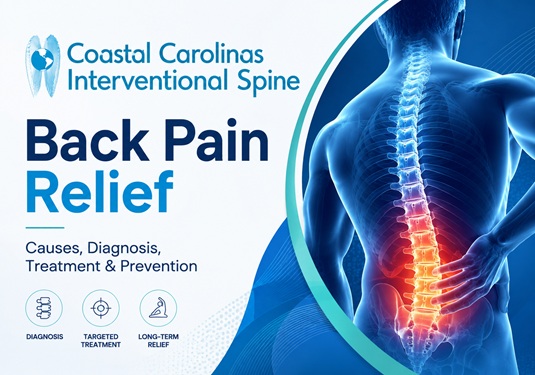
Finding effective back pain relief starts with understanding why symptoms are happening and how they affect daily life. Pain may begin after lifting, twisting, or falling, or it may develop slowly because of changes in the joints, discs, muscles, bones, or nerves of the spine.
At Coastal Carolinas Interventional Spine, patients receive a focused evaluation designed to identify possible pain sources and guide treatment. The goal is to improve comfort and function while using nonsurgical care when appropriate.
What Can Cause Back Pain?
The spine includes vertebrae, discs, joints, ligaments, muscles, and nerves. Problems involving any of these structures can lead to back pain, and some patients may have more than one contributing cause.
Common causes include:
- Muscle strains or ligament sprains
- Herniated or bulging discs
- Degenerative disc changes
- Arthritis in the spine
- Spinal stenosis
- Sciatica or nerve compression
- Facet joint irritation
- Sacroiliac joint dysfunction
- Osteoporosis-related compression fractures
- Repetitive strain or poor body mechanics
The location of discomfort does not always identify its source. For example, lower spine symptoms may come from a strained muscle, irritated joint, damaged disc, or compressed nerve.
When Should You Seek Back Pain Relief?
Some symptoms improve with activity changes and basic home care. However, back pain relief may require a medical evaluation when discomfort lasts for several weeks, keeps returning, or interferes with normal activities.
Consider scheduling an evaluation if symptoms:
- Disrupt sleep
- Make walking difficult
- Limit work or household tasks
- Travel into the buttock, leg, shoulder, or arm
- Cause tingling or numbness
- Lead to weakness
- Continue despite conservative treatment
A pain specialist can assess the pattern of symptoms and determine whether further testing or targeted care may be appropriate.
How Is the Source of Spine Pain Diagnosed?
Diagnosis usually starts with a discussion about when symptoms began, previous injuries, medical history, and activities that make discomfort better or worse. The doctor may also ask whether symptoms radiate or affect strength, balance, or sensation.
A physical examination may evaluate:
- Posture
- Range of motion
- Reflexes
- Muscle strength
- Balance
- Sensation
- Areas of tenderness
- Signs of nerve irritation
Imaging such as X-rays, MRI scans, or CT scans may help in certain situations. However, not every patient needs imaging before treatment can begin.
In some cases, diagnostic injections can help determine whether a specific joint, nerve, or spinal structure is contributing to symptoms.
What Back Pain Relief and Treatment Options May Help?
Treatment depends on the diagnosis, how long symptoms have lasted, and how much they affect mobility. A personalized plan may combine several forms of pain relief rather than relying on one treatment alone.
Options may include:
- Activity modification
- Heat or cold therapy
- Physical therapy
- Therapeutic exercise
- Medication management
- Image-guided injections
- Nerve blocks
- Radiofrequency ablation
- Posture and movement changes
Many spine conditions can be managed without surgery. At Coastal Carolinas Interventional Spine, treatment recommendations are based on the patient’s symptoms, examination findings, and individual goals.
Surgery may become appropriate when a serious structural condition, severe nerve compression, spinal instability, or progressive weakness requires a surgical evaluation.
Patient Experience With Dr. Willeford
Patient experiences can also provide helpful insight into the care process. Jacqui O’Shaughnessy shared the following Google review after seeing Dr. Willeford for a back issue:
“I recently saw Dr. Willeford for a back issue. My appointments were on time and the doctor was very caring and informative. Thank you for helping me receive the best in healthcare!”
Individual results and experiences vary. A medical evaluation is needed to determine which treatment options may be appropriate for each patient.
When Can Spine Symptoms Be an Emergency?
Most spine discomfort does not require emergency treatment. However, certain symptoms can signal a serious condition that needs immediate medical attention.
Seek urgent care for symptoms that occur with:
- Loss of bladder or bowel control
- Difficulty urinating
- Numbness around the groin or inner thighs
- Sudden or worsening leg weakness
- Severe pain following a major fall or accident
- Fever or chills
- Unexplained weight loss
- Severe abdominal symptoms
- Rapid neurological changes
These symptoms should not wait for a routine office appointment.
Back Pain Relief: How Can Treatment Improve Daily Function?
Long-lasting discomfort can affect more than the spine. People may begin limiting movement because they worry that normal activities will make symptoms worse.
Over time, reduced activity can contribute to:
- Muscle weakness
- Joint stiffness
- Reduced endurance
- Poor balance
- Sleep disruption
- Difficulty performing everyday tasks
For this reason, effective back pain relief should address both symptoms and function. The goal is to help patients move more comfortably and return to appropriate activities whenever possible.
Can You Reduce the Risk of Recurring Spine Problems?
Not every spine problem can be prevented. Still, healthy daily habits may reduce unnecessary strain and support long-term mobility.
Helpful habits include staying active, strengthening core muscles, using proper lifting techniques, and changing positions regularly throughout the day. Good workplace ergonomics can also reduce repeated stress.
Maintaining healthy bones is especially important as people age. Patients with osteoporosis or other existing conditions should ask their medical provider which exercises and activities are appropriate.
Frequently Asked Questions About Back Pain Relief
What is the first step when spine pain keeps coming back?
The first step is usually a medical history and physical examination. The doctor can then decide whether conservative treatment, imaging, or additional diagnostic testing is appropriate.
Can treatment help without surgery?
Yes. Many patients improve with physical therapy, exercise, medication strategies, lifestyle changes, or targeted procedures used in pain management.
Do I need an MRI before seeing a spine doctor?
Not necessarily. Imaging decisions depend on symptoms, examination findings, medical history, and whether the results are likely to change the treatment plan.
What does radiating pain mean?
Radiating symptoms may travel from the spine into another area, such as the buttock, leg, shoulder, or arm. Burning, tingling, numbness, or weakness may also suggest nerve involvement.
How long should I wait before scheduling an evaluation?
Consider an evaluation when symptoms last more than a few weeks, repeatedly return, interfere with sleep or walking, or do not improve with conservative measures.
Are injections the right treatment for everyone?
No. Procedures are recommended only when the diagnosis and symptoms suggest they may be useful. Some patients may benefit more from exercise, therapy, medication changes, or another approach.
When should I go to the emergency room?
Seek immediate care for loss of bladder or bowel control, saddle-area numbness, sudden severe weakness, major trauma, or other rapidly worsening neurological symptoms.
Back Pain Relief in North Myrtle Beach
Persistent spine symptoms can make everyday tasks harder, but an accurate evaluation can help clarify the next step. Coastal Carolinas Interventional Spine provides patient-focused care for people dealing with acute, recurring, or chronic spine-related discomfort in the North Myrtle Beach area.
If symptoms are limiting your mobility, sleep, or daily routine, call Coastal Carolinas Interventional Spine at (910) 755-6060 to schedule an evaluation and learn which treatment options may be appropriate for you.
This article is for educational purposes only and does not replace individualized medical advice, diagnosis, treatment, or emergency care.
Check our Facebook page for more educational articles
Coastal Carolinas Interventional Spine
416 Main Street
North Myrtle Beach, SC 29582
(910) 755-6060
https://www.coastalcarolinasinterventionalspine.com/
[email protected]
Coastal Carolinas Interventional Spine
10 Doctor Circle
Suite #2
Supply, NC 28462
Areas Served:
Myrtle Beach SC, North Myrtle Beach SC, Little River SC, Shallotte NC, Calabash NC, Supply NC